While thousands of Sahrawis in Laayoune continue to face unemployment, marginalization, and economic exclusion, leaked official documents obtained by sahararepublic.comAttachment.png reveal how vast areas of public land in Western Sahara have been transferred to companies linked to powerful Moroccan political figures at symbolic prices.
The leaked documents, issued by Morocco’s State Property Directorate, expose what appears to be a systematic mechanism of political favoritism, land appropriation, and economic domination in the occupied territory.
At the center of the controversy is Moulay Hamdi Ould Errachid, one of the most influential political figures in Western Sahara and a key ally of the Moroccan establishment in the region.
44 Hectares Transferred at Symbolic Prices
One of the leaked documents, identified as Decision No. 2023-115, concerns the transfer of approximately 44 hectares of state-owned land in Laayoune to the company MYHER INDUSTRIE.
According to the official document, the land was transferred for only 30 Moroccan dirhams per square meter, a price dramatically below the market value of strategic industrial and urban land in the city.
The document carries official Moroccan administrative stamps and signatures, confirming the legality of the procedure under Moroccan administration. However, the deal raises serious questions about abuse of political power, conflict of interest, and the use of state institutions to enrich politically connected networks.
The beneficiary is not an ordinary investor, but a political figure with extensive influence over local institutions, elected councils, and economic decision-making in the territory.
A Family Network Controlling Strategic Assets
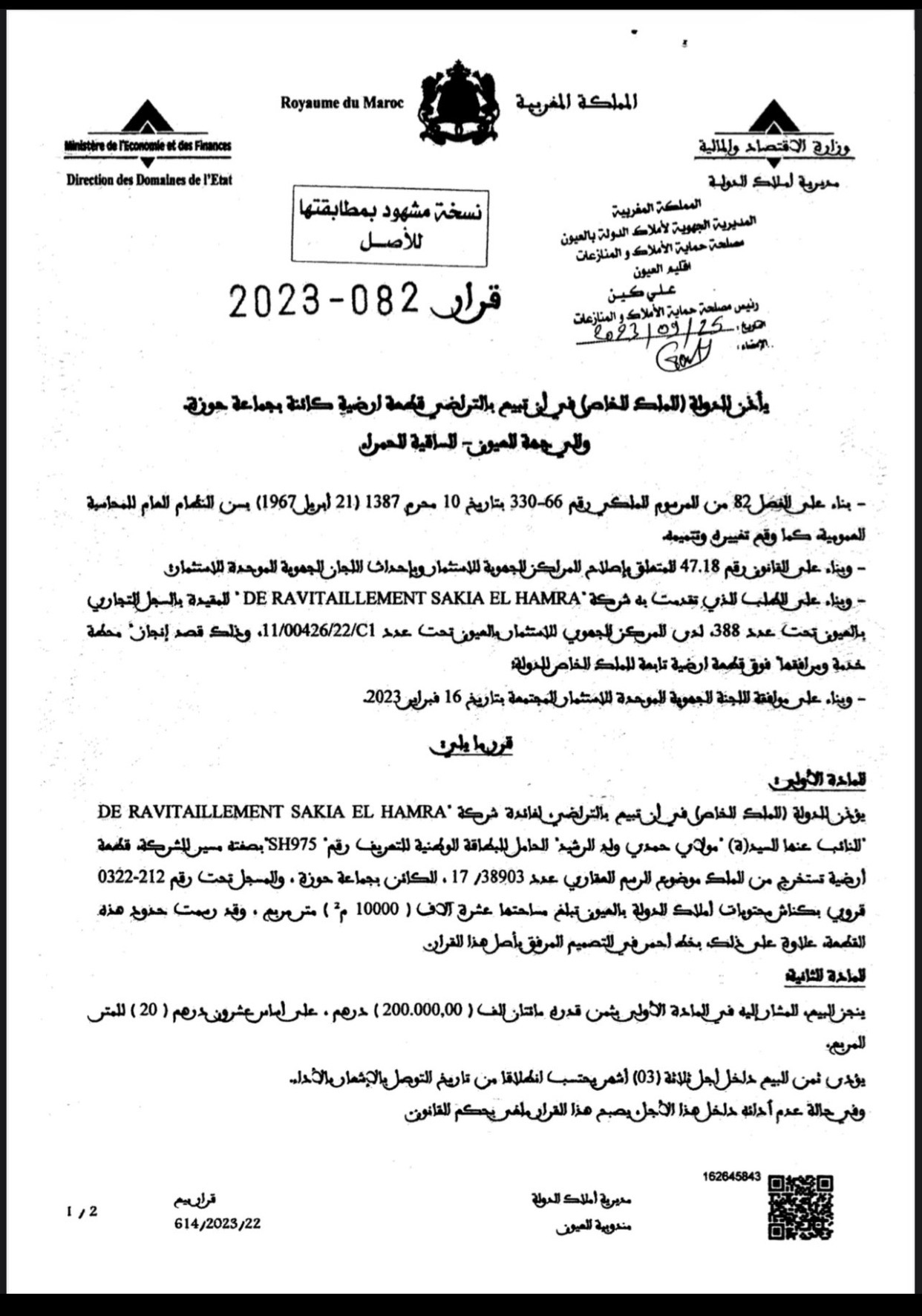
Another leaked document, Decision No. 2023-082, reveals an additional land transfer involving the company DE RAVITAILLEMENT SAKIA EL HAMRA, also linked to the Ould Errachid family network.
The repeated appearance of companies tied to the same political circle suggests the existence of a consolidated system of economic control over land and investment opportunities in Western Sahara.
These documents expose how strategic public assets are concentrated in the hands of a small elite connected to Rabat, while ordinary Sahrawis remain excluded from meaningful economic participation.
Morocco’s Hidden Power Structure in Western Sahara
Over the years, Moulay Hamdi Ould Errachid has emerged as one of the central figures of Moroccan influence in Western Sahara, combining political authority, business interests, and administrative power.
His influence extends far beyond local politics. It reaches into land allocation, public contracts, investment permits, and economic structures that reinforce Morocco’s control over the territory through financial dependency and patronage networks.
The leaked documents provide rare insight into how economic privileges are distributed to politically loyal actors while Sahrawis are systematically sidelined from ownership, investment, and access to wealth generated from their own land.
Western Sahara’s Wealth Extracted While Sahrawis Remain Marginalized
Western Sahara is rich in natural resources, including phosphates, fisheries, renewable energy potential, and valuable coastal and urban land. Yet these resources have not translated into social justice or economic opportunity for the indigenous Sahrawi population.
Instead, wealth continues to accumulate within networks closely linked to the Moroccan state apparatus and its local allies.
The leaked records reinforce longstanding accusations that Morocco’s administration of Western Sahara operates through a model of economic exploitation, where land and resources are distributed among loyal political elites while the local population faces exclusion and dependency.
A Scandal With International Implications
The significance of these documents goes beyond local corruption allegations. They raise broader legal and political questions regarding the exploitation of land and resources in a territory recognized internationally as disputed.
The revelations may intensify international scrutiny over Morocco’s economic activities in Western Sahara, particularly regarding transparency, resource exploitation, and the role of political elites in controlling public assets.
What these documents reveal is not simply isolated corruption. They expose a wider system in which political power, economic privilege, and territorial control operate together to consolidate Moroccan authority in Western Sahara while denying the Sahrawi people meaningful control over their land, wealth, and future.