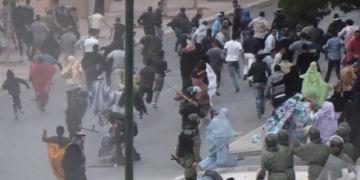
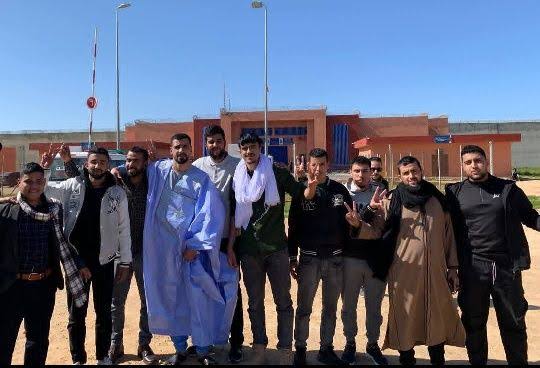
In a new development reflecting the continued pressure on Sahrawi activists in Western Sahara, former Sahrawi political prisoner and student Hussein Bourkba appeared on Friday before the Court of First Instance in the city of Guelmim, only weeks after his release from prison where he had served a two-year sentence related to his peaceful student activism at university in defense of the Sahrawi people’s right to self-determination.
The case, which has once again come to public attention, highlights what observers describe as a continuing pattern of judicial and security pressure targeting Sahrawi activists even after they have completed their prison sentences in Moroccan detention facilities.
Sudden Arrest and Hours of Interrogation
According to statements made by Hussein Bourkba, he was subjected to a sudden arrest the day before his court appearance. Members of the Moroccan Royal Gendarmerie reportedly stopped the taxi he was traveling in, forced him out of the vehicle, restrained him, and transported him to an interrogation facility without providing any prior explanation for the arrest.
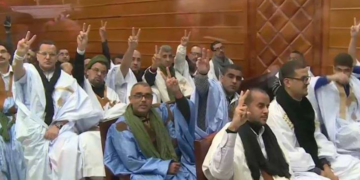
During the interrogation, which lasted nearly eight hours, investigators focused mainly on the public reception he received following his release in the town of Assa. Questions also centered on the raising of the Sahrawi national flag and on identifying activists who had participated in the gathering.
Observers say that the nature of these questions suggests an attempt to closely monitor and control the social and political activities of Sahrawi activists even after their release from prison.
Repeated Charges Against Activists
According to Bourkba, authorities justified the procedure using the accusation of “unauthorized gathering,” a charge that has frequently been used in cases involving Sahrawi activists connected to peaceful demonstrations or public assemblies.
After hours of questioning, Bourkba was temporarily released but ordered to appear before the Court of First Instance in Guelmim the following morning. Following the hearing, the court decided to postpone the case until April 6, when further developments in the case are expected.
Between Legal Procedure and Political Pressure
Human rights observers believe that summoning Hussein Bourkba again so shortly after his release raises serious concerns and may reflect broader patterns of pressure against Sahrawi activists in Western Sahara.
Several human rights reports have noted that activists advocating for the Sahrawi people’s right to self-determination are often subjected to repeated legal proceedings or security measures that critics interpret as restrictions on freedom of expression and peaceful assembly.
A Case That Goes Beyond One Individual
The case of Hussein Bourkba appears to represent more than a single judicial matter. For many observers, it reflects a broader reality faced by numerous Sahrawi activists who encounter legal or security challenges related to their political or student activities.
As the next hearing scheduled for April 6 approaches, attention is turning toward how the case will evolve. At the same time, international human rights organizations continue to call for closer monitoring of the human rights situation in Western Sahara and for guarantees of fundamental freedoms, particularly the rights to free expression and peaceful assembly.
What is happening today to Sahrawi student Hussein Bourkba once again raises a crucial question for the international community: to what extent can activists freely express their political views in a territory where the political conflict has remained unresolved for decades?
While the world awaits the outcome of the next court session, this case remains another test of the state of civil liberties and human rights in Western Sahara.