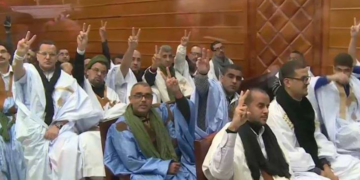
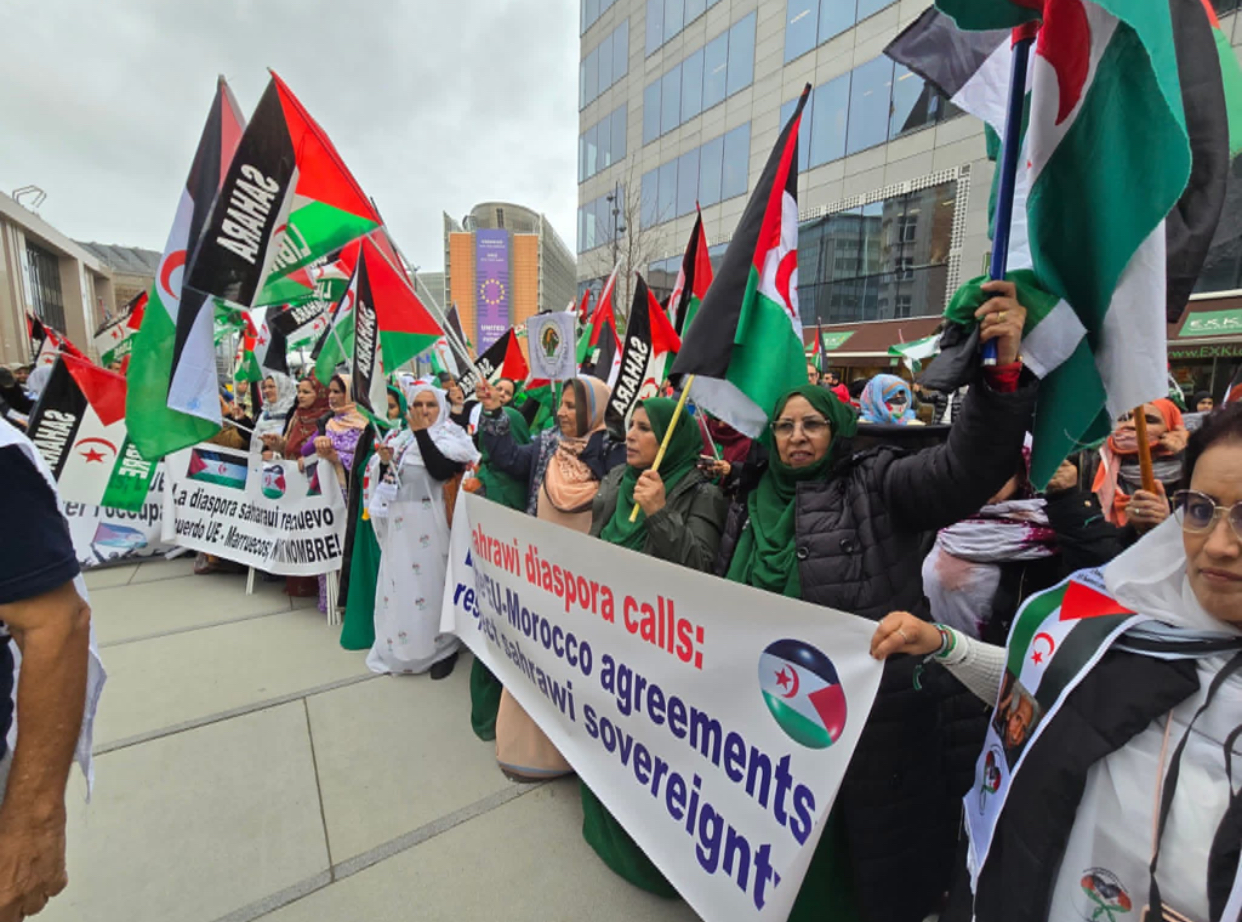
Sahrawi communities across Europe organized a large demonstration today in front of the European Commission in Brussels, denouncing the continued inclusion of Western Sahara—a Non-Self-Governing Territory—within trade and fisheries agreements signed between the European Union and Morocco.
Protesters condemned what they described as the EU’s “direct complicity” in the economic exploitation of a territory that does not legally belong to Morocco, as confirmed repeatedly by the Court of Justice of the European Union (CJEU), which ruled that Western Sahara is a distinct and separate territory with no sovereignty for Morocco over it.
⸻
Clear Sahrawi Rejection of EU Agreements Covering the Occupied Territory
The demonstration featured:
• Sahrawi national flags,
• banners rejecting the plunder of natural resources,
• and calls for the EU to respect international law and the right of the Sahrawi people to consent to any economic activity in their land.
Participants stressed that the EU’s continuous attempts to extend its agreements with Morocco to include Western Sahara constitute a violation of international law and an indirect endorsement of the Moroccan occupation.
⸻
Mechanisms of Resource Exploitation: An Engine of Occupation
According to Sahrawi activists, the Moroccan state has established an extensive system of economic extraction and demographic engineering in Western Sahara. Key mechanisms include:
1. Phosphate Extraction
The vast phosphate reserves of the Bou Craa mine, among the largest in the world, are exported in massive quantities every year.
The revenues do not benefit the Sahrawi population but go directly to Moroccan state institutions and companies linked to the ruling elite.
2. Illegal Fishing Agreements
The coastline of Western Sahara is one of the richest in marine biodiversity.
Yet foreign—mainly European—vessels operate there under agreements made with Morocco without the consent of the Sahrawi people, in clear defiance of international legal standards.
3. Sand and Mineral Extraction
Huge quantities of Saharan sand are exported yearly to Spain and the Canary Islands.
Meanwhile, foreign energy companies engage in oil and gas exploration in the occupied waters in partnership with the Moroccan government.
4. Renewable Energy Projects
Large solar and wind energy projects are being built in occupied territory:
• without consultation of the Sahrawi people,
• without local benefit,
• and in contradiction with international law.
5. Deliberate Underdevelopment
Despite the massive wealth extracted from the land, the region suffers:
• chronic marginalization,
• high unemployment,
• and systematic exclusion of Sahrawis from benefiting economically.
⸻
Economic Strangulation and Political Repression
Speakers at the protest denounced what they described as a policy of economic strangulation imposed on Sahrawis who oppose Moroccan rule.
This includes:
• creating structural unemployment for Sahrawi youth,
• depriving activists and their families of opportunities,
• and using economic pressure as a tool of political control.
According to participants, such practices form part of a broader strategy aimed at silencing Sahrawi voices inside the occupied territories.
⸻
A Message to the European Union: Respect International Law
The protest delivered a clear message to the European Commission and EU member states:
• uphold the rulings of the CJEU,
• end all agreements that include Western Sahara without the consent of its people,
• stop providing economic and political cover for Morocco’s occupation,
• and support the UN peace process toward a just and lasting solution.
Protesters emphasized that the EU’s silence and its continued signing of agreements with Morocco encourages the ongoing occupation and prolongs Sahrawi suffering.
⸻
Conclusion: A Unified Voice Against the Plunder of a People
Today’s demonstration is a strong reminder that:
• the Sahrawi diaspora in Europe is becoming increasingly organized and influential,
• economic exploitation has become a central battlefield in the Sahrawi struggle,
• and pressure on the EU will continue until it ends its involvement in unlawful resource extraction.
The message from Brussels was loud and clear:
“The natural resources of Western Sahara belong to its people—no agreement can legitimize their theft.”