Urgent Appeal to the United Nations to Act Before It Is Too Late
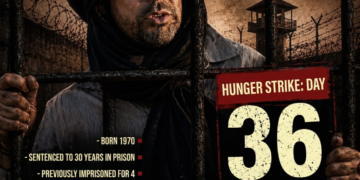
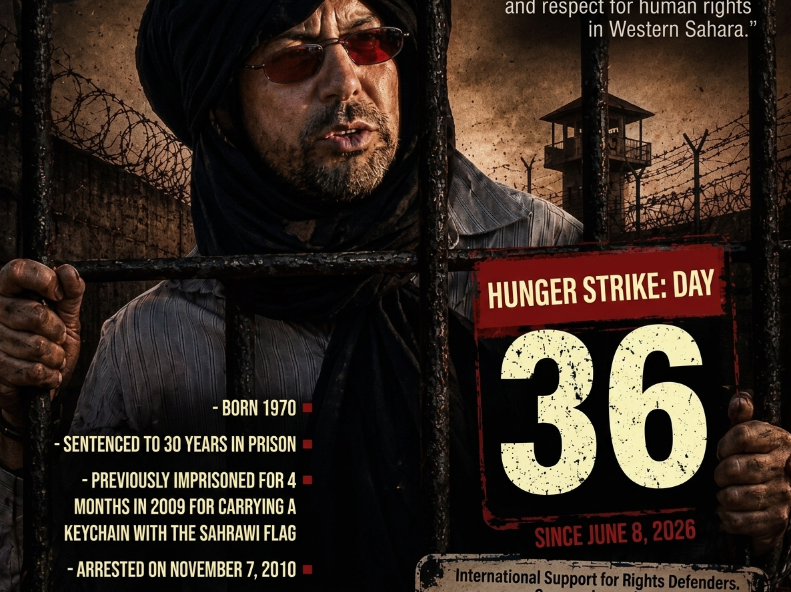
Sahrawi political prisoner and human rights defender Naâma Abdi Moussa Asfari has entered his 36th consecutive day of open-ended hunger strike, amid growing concerns over his deteriorating health condition and urgent calls from his family, supporters, and human rights advocates for immediate international intervention to protect his life and ensure respect for his fundamental rights.
Since 8 June 2026, Naâma Asfari has been on hunger strike inside Kenitra Central Prison, in a protest that his supporters say follows more than fifteen years of detention under conditions they describe as a violation of his basic human and legal rights.
After spending over a decade and a half behind bars, the health situation of the 56-year-old Sahrawi activist has become a matter of increasing concern. His family and supporters warn that the continuation of his hunger strike represents a direct threat to his life, particularly in the absence of what they describe as adequate medical monitoring and independent assessment of his condition.
Naâma Asfari is one of the most prominent detainees of the Gdeim Izik prisoner group, whose cases have attracted attention from international human rights organizations and United Nations mechanisms. His supporters maintain that his case is not an isolated matter, but part of a broader human rights issue concerning the treatment of Sahrawi prisoners and their right to fair judicial guarantees and due process.
According to his family, his suffering has been compounded by restrictions affecting his contact with relatives. His wife, French human rights activist Claude Mangin, has reportedly been prevented from visiting him for an extended period, a situation the family considers a violation of the right to maintain family and humanitarian ties.
An Urgent Appeal to the International Community
As Naâma Asfari’s hunger strike reaches a critical stage, growing appeals are being directed toward the United Nations and international humanitarian bodies, calling for immediate action, including:
Ensuring that Naâma Asfari receives urgent and appropriate medical care without delay.
Allowing independent humanitarian organizations, including the International Committee of the Red Cross, access to assess his health condition and detention circumstances.
Calling on United Nations human rights mechanisms to urgently follow up on his case.
Guaranteeing respect for the fundamental right to life and physical integrity of all hunger-striking prisoners.
Supporters have also called for the implementation of recommendations and decisions issued by United Nations mechanisms concerning arbitrary detention and prisoners’ rights, warning that continued inaction could lead to irreversible consequences.
An International Responsibility Before a Humanitarian Tragedy Occurs
A hunger strike represents one of the most extreme forms of peaceful protest, in which a prisoner places his own body and life at risk in order to make his voice heard. In the case of Naâma Asfari, the passing of 36 days without a resolution has transformed the situation into an urgent humanitarian matter requiring immediate attention.
Protecting human life is not a political issue; it is a fundamental legal and moral obligation. The United Nations, international humanitarian organizations, and human rights bodies are therefore urged to take concrete steps to ensure that this case does not become another preventable humanitarian tragedy.
Time is running out, and the life of Naâma Asfari has become an urgent humanitarian responsibility for the international community.